Tuesday, August 13, 2013

Here is an eye-opening Tidbit Tuesday tip!


Did you know that tire pressure is one of the most overlooked areas of general maintenance?  Only one out of ten drivers checks his or her tire pressure correctly, even though tire pressure is one of the most important aspects of car maintenance!  That's compared to seven out of ten that wash their car regularly.  Food for thought!

Thursday, August 8, 2013

Here are a few great deals you don't want to miss out on!

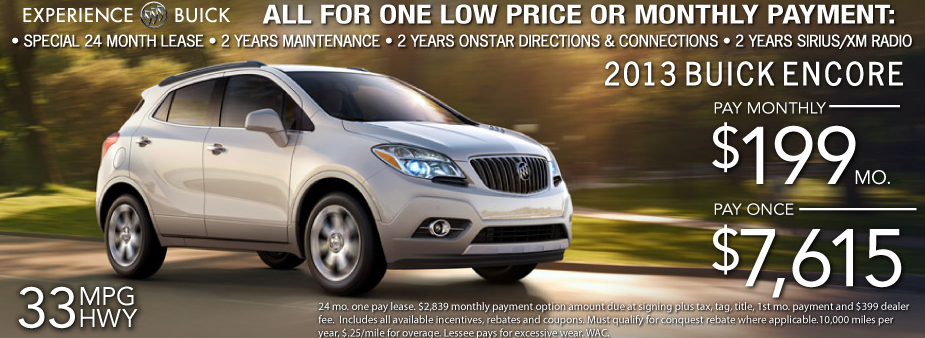
Get a brand new 2013 GMC Terrain with some great options for only $199 a month!

Or perhaps the the compact-yet-fully-featured Buick Encore!

No matter what you choose, you can rely on Huston Cadillac Buick GMC to work with you through the entire process!  We work with all of the best creditors and we will do whatever it takes to get you into the car you want at a great price!

See the rest of our great deals below!

Tuesday, July 16, 2013

Check out this great tip for scheduling car maintenance!


We know.  Scheduling and bringing your car in for maintenance can be a pain.  But it has to be done-- you invested a lot of money into your vehicle, and you want to keep it running in tip-top shape for as long as possible!  That's why we've made it easy to schedule service right from your personal computer.  With just a few pieces of information, we can get you penciled in for an appointment with one of our service professionals.  Click the link below to give it a try!

Tuesday, July 9, 2013

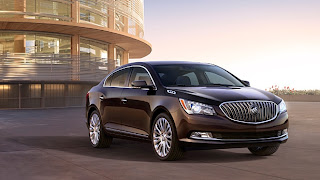
This is the new Buick; Sleeker, safer, and better


2014 Buick Lacrosse

After teetering on the brink of extinction only a few years ago, Buick seems to be back in the black and on a roll these days. The automaker has done a rather impressive job shedding its unfortunate but well-deserved "built for seniors" image by replacing the lumbering, stodgy cars of its past, with sleeker, sexier looking new machines equipped with the latest performance, safety and entertainment technologies.

Take the recently redesigned Enclave, for instance. It brings a comfortable, upscale feel to the midsize crossover segment with lots of amenities, a well-designed interior, and a smooth ride. Similarly, both the Regal and Verano sedans offer composed handling, high-quality interiors, and a standard features galore.

Now, it's time for the LaCrosse, the automaker's flagship and the vehicle that started the company's whole revival movement, to get a refresh. And while the updates for model year 2014 might seem insignificant on the surface, they are well executed as a whole and will help the car compete better against its pricier and more overtly luxurious European rivals – the Mercedes-Benz E-Class, Audi A6, BMW 5 Series, and Volvo S80 –  which until recently held a distinct advantage in nearly every respect. Other competitors include other "affordable" luxury cars such as the Acura TL, Lincoln MKZ, Lexus ES, Chrysler 300, Toyota Avalon, and Nissan Maxima (the LaCrosse falls somewhere in between the aforementioned two groups).

On the outside, the LaCrosse's sheet-metal gets a little s more dramatic, front and rear. Upfront, you'll find a somewhat-larger waterfall grille, similar in design to the ones featured by its smaller siblings the Regal and Verano, and new headlamps with LED technology. The pair gives the car a slightly more aggressive demeanor. Ditto out back, where the taillights now are LEDs and tied together with a slim chrome strip across the trunk-lid.

Overall, the car looks clean and appealing. That said, it still seems somewhat chunky. No matter how sporty and aggressive Buick tries to make this car look, there's no disguising that this is a big, hefty car.

There have been more significant improvements inside the car. The cabin is more refined than ever before and ergonomically designed. Material quality was good in the 2013, but is even better in the 2014. And there is plenty of room to seat five comfortably.

The most notable improvements, however, are on the tech side. First, we give kudos to the updated IntelliLink infotainment system, which now features swipe-and-drag controls like a tablet, similar to Cadillac's CUE system but more streamlined. It's intuitive and easy to use, cutting the center-stack-button count from 17 to seven.

Also, Buick is offering a pair of cutting-edge safety packages designed to keep the driver alert to his surroundings. Driver Confidence I ($2,125) includes forward-collision alert, lane-departure warning, lane-change alert, side blind-zone alert, rear cross-traffic alert, HID articulating headlamps, fog lamps and a head-up display. For another $1,745 you can add Driver Confidence II and get a haptic driver's seat (it vibrates to alert the driver rather than beeping), adaptive cruise control, and collision preparation, which includes "mitigation" braking if the driver doesn't hit the pedal soon enough.

On the road, we were pleasantly surprised by how adeptly or nimbly this car handled the various road conditions we threw at it. Note: The LaCrosse is not a sport sedan. It is designed for soaking up miles in comfort rather than blasting down back roads at breakneck speeds. Even so, we found it to be responsive, well behaved, and handle every twist and turn, tight or sweeping, with relative aplomb (better than its predecessors) thanks to the optional magnetic adjustable suspension, which includes real-time adjustable damping.

Steering was also precise with excellent feedback. Road imperfections were well-damped; you can hear them, but you don't much feel them through the steering wheel.

Unfortunately, this was only true with the front-wheel drive models. Adaptive damping is not available in all-wheel drive cars, which we found to lack the smooth ride and light steering of the front-wheel drive models. They simply felt simply felt heavy.

As far as the safety features are concerned, the ones that could be tested without bending metal operated just as advertised. In fact, the adaptive cruise control, blind-spot monitoring, and lane departure warning were some of the best of breed we have ever tested.

Under the hood, the base model comes is equipped with a four-cylinder 182-hp engine with GM's eAssist mild-hybrid technology or a 304-hp V6. Both mate to six-speed automatic transmission. Both were quiet and returned respectable, refined performance. Acceleration was smooth, but not overly quick. A little more oomph would have been appreciated. But you certainly won't be wanting when it comes time to pass another vehicle or enter a crowded roadway. The eAssist earns an impressive EPA highway fuel rating of 36 mpg, while the V6 deliver 28 mpg.

Tuesday, June 25, 2013

Here's a Tuesday Tip from us to you!


The serpentine belts on your engine keep many of the mechanical systems of your vehicle operating, including the cooling system, the power steering, the air conditioning, the electrical charging system and other major components. Many modern engines use a single belt to keep all those drive pulleys spinning, so if that belt kicks the bucket, all of those systems will stop working at the same time. When it’s 100+ degrees outside, that’s a big problem. Fortunately, changing your serpentine belt is one of the cheapest and easiest parts of your vehicle’s maintenance routine.
Major fluctuations in temperature have a tendency take their toll on rubber components–such as the changing of seasons–so check your belts for signs of brittleness and cracking. If you find any, now is the time to ditch the old belt and replace it with a new one. Most experts agree that replacing the belts every 36,000 – 48,000 miles is an optimal interval to avoid problems down the road.

Tuesday, June 18, 2013

Cadillac's 2014 CTS Looks to Impress the World


General Motors is about to close the ugliest and darkest chapter of its history book, just as soon as the U.S. Treasury dumps its remaining shares in the company. By year's end, GM plans to once again return to investment grade, and in its best financial shape in more than a decade.
GM also has another bright spot this year: Its Cadillac lineup has surged 38% year to date -- its best YTD increase in nearly four decades. Its success is driven by new Cadillac models ATS, CTS, and XTS. Let's look at the 2014 CTS and see what it brings to the table for consumers and investors alike.

Overview and exterior
Typically the CTS has been Cadillac's hero, but last year's introduction of the ATS gives Cadillac a sidekick to its all-new 2014 CTS due out this October.
"CTS has always been Cadillac's centerpiece, and as our brand expands and elevates, the car properly grows to its true place," said David Leone, CTS executive chief engineer, in a press release. "With last year's addition of the award-winning ATS compact luxury sedan, CTS will directly challenge the luxury midsize competition with uncompromised performance, luxury, and technology."
Looking at some of the new tweaks and upgrades in the next-generation CTS, it's clear Cadillac is putting its money where its mouth is -- but it will ask you to pay up roughly $6,000 more for the new model, according toAutomotive News.
It's going to offer more interior space, power, and technology, while the new exterior design becomes longer, lower, and leaner. While the vehicle itself gets larger and roomier, it'll be on a strict diet and will shed about 244 pounds from its previous model -- expecting to be the lightest midsize luxury vehicle.
In addition to the weight loss, the 2014 CTS will be offered with a choice of three powertrains and two engines. One of the engines, a 2.0L turbocharged four-cylinder, will put out an impressive 272 horsepower and will go from 0 to 60 in 6.1 seconds -- 1.5 seconds quicker than its predecessor.
Cadillac's CTS also has a 3.6L V6 engine, and in its premium Vsport model package -- which contains the highest-performing components -- it puts out 420 HP. However, all that power and premium options bring a hefty price tag of nearly $60,000 -- roughly $13,000 more than the standard-version CTS.
Interior
All the CTS models will be equipped with Cadillac's prized "CUE" system for connectivity, featuring a large 8-inch touchscreen. Here's a tidbit that was music to my ears: The CTS will also come with a 13-speaker Bose premium audio system with HD radio capability.

Cadillac's 2014 CTS. Photo: General Motors.
Cadillac had me at "Bose system," but here's a list of other CTS interior features, according to a GM press release:
  • Cadillac's first 20-way adjustable front seats.
  • A motorized cup-holder lid in the center console.
  • Heated and cooled (ventilated) front seats and heated steering wheel.
  • Electronically locking glove box.
  • Electronic park brake.
  • Adaptive remote start feature that also activates the climate control system.
In addition to those minor features, it has a plethora of safety features and options. For example, the 2014 will be the first Cadillac to offer "Automatic Parking Assist," similar to Ford's feature that parks itself in parallel spaces. It also offers a "Driver Awareness Package" that has vibrating pulses in the driver's seat to bring attention to an imminent collision -- a patented feature. 
Investing takeaway
Luxury lines bring in a high transaction price and fatter margins than standard vehicles, and it's important to be able to step your loyal consumers up as their purchasing power grows over time. One complaint from GM investors is that the company isn't nearly as profitable as it should be for the globe's second leading automaker in sales -- and that looks to change. For investors, GM is an intriguing opportunity because it's years behind Ford in operating efficiencies and has a lot of room to run over the next few years in terms of profitability.
These two crosstown rivals have much to learn from each other. If Ford can take notes from Cadillac's success and apply it to its Lincoln brand, it will be a huge step for growing top-line revenues. If GM can apply Ford's efficient global platform and run its plants and operations at a high percentage of capacity, as Ford does, it will become immensely more profitable. If a hypothetical automaker had GM's top-line success, in combination with Ford's bottom-line success, the result would easily be the best automaker on the globe. Time will tell which company learns its lesson first, but both automakers present us with an incredible investment opportunity as automotive sales rebound in the U.S. and around the world.

Thursday, June 6, 2013

2014 GMC Sierra 1500 -- The Gentleman's Pickup


Courtesy of Car and Driver
Identical twins can be hard to tell apart, but it gets easier when they’re wearing name tags. Maybe that’s why GM attaches big Chevrolet and GMC badges on its pickup-truck twins, the Silverado and the Sierra.
The Chevy Silverado and GMC Sierra aren’t quite identical, but engines, transmissions, chassis, and most of the sheetmetal are shared. What’s obviously different is the front-end styling. The Sierra replaces the Silverado’s stacked headlights with simpler, classier-looking small projector-beam units that are accented with LEDs on the top-dog SLT trim level. The grille, the front bumpers, the fenders, and the aluminum hood are unique to the Sierra. Black plastic trim around the fender wells and a chrome accent along the base of the side windows are more Sierra tells.
Aside from the GMC badging, the interior décor of the Sierra is, again, nearly identical to that of the bow-tie truck. Aluminum trim on all versions of the Sierra replaces what’s silver-colored in the Silverado, and wood accents are peppered throughout the top-spec SLT interiors.
Direct-Injected V-8
With those few differences, it’s not surprising that the Sierra acts just like the Silverado. The 355-hp, 5.3-liter V-8 broadcasts the same mellow V-8 soundtrack here as it does in the Chevy. Even without provoking the throttle, the 383 lb-ft of torque give an apology-worthy shove. We recently tested a Silverado LTZ crew cab equipped with the 5.3-liter, and it returned a 0-to-60 time of 6.7 seconds. We have no reason to doubt that a comparably equipped Sierra would accomplish the task in the same time.
Cruising on the highway, the 5.3 switches to V-4 mode to help save fuel. In two-wheel-drive guise, the Sierra V-8 returns an EPA-estimated 16 city mpg and 23 highway. Four-wheel-drive versions with the V-8 manage 16/22 mpg. For those interested in a little more economy at the expense of some power, there’s finally a credible V-6 option from GM. GMC hasn’t released any EPA fuel-economy estimates yet for the six; we’ll let you know as soon as it does.
Six Serious Cylinders
The standard 4.3-liter V-6 has been thoroughly redone. Not just a light nip and tuck, the engine has undergone a Michael Jackson–grade transformation. It might be distantly related to the Vortec 4300 that powered Chevy Astros and GMC Safaris when “Thriller” was still a hit, but the performance and the refinement are in line with that of 21st century V-6s. The 90-degree bank angle remains—a reminder of the engine’s V-8 roots—but it has been enhanced from top to bottom with variable-valve timing, direct fuel injection, and cylinder deactivation. Power is up by 90 horsepower, and torque rises to 305 lb-ft, an improvement of 45 lb-ft over last year’s 4.3-liter V-6. Remember theSyclone and Typhoon supertrucks? The new naturally aspirated 285-hp 4.3-liter makes five more horsepower than the turbocharged 4.3-liter V-6s could muster.

Even lugging the heavy crew-cab version, the V-6 provides what feels like sub-eight-second runs to 60 mph. Unlike the smaller-displacement V-6s from Ford and Ram, the 4.3-liter has good low-end grunt and consequently feels less strained than the competition. The car-derivedFord 3.7-liter V-6 and Ram 3.6-liter V-6 both make nearly 305 horsepower, but they fall short of the Sierra’s figure. The V-6 Sierra can tow 7200 pounds, which is 500 more than the V-6 Ford and 700 more than the V-6 Ram. This GM V-6 was designed from the git-go for truck use and is essentially a small-block Chevy V-8 with two fewer cylinders.
The rest of the Sierra experience is, not surprisingly, pure Silverado. No matter what engine is under the aluminum hood, both pickups have a quiet demeanor, an occasionally choppy but otherwise soft ride, and a smaller feel from behind the wheel than that of those big-rig-emulating competitors. The Sierra’s steering is accurate and doesn’t require constant corrections. A firm and confidence-inspiring brake pedal is almost sports-car-like, and the braking distances recorded by the Sierra’s Chevrolet analog were class-leading.
Crew cabs are arriving at dealerships now, extended-cab models soon will follow, and the regular-cab version will debut by the end of the summer. Two-wheel-drive Sierra crew cabs start at $33,210; an equivalent Silverado opens at $32,710, but the Chevy lacks a few features, such as steering-wheel audio controls and an eight-inch touch screen, that justify the cost differential. Even discounting the small bump in standard equipment, the Sierra strikes us as the more attractive of the two GM full-size pickups. If you look hard enough, one twin will always be the better-looking one.